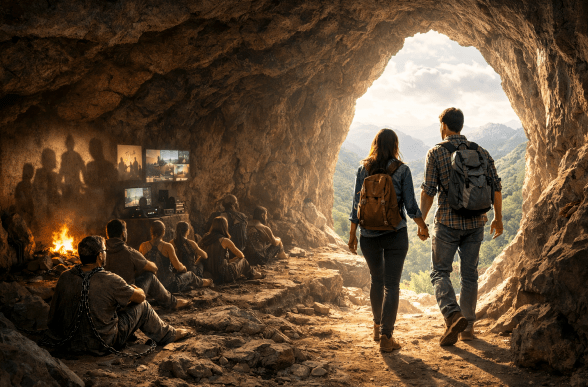
In Plato’s timeless Allegory of the Cave, we are presented with a haunting image of human limitation: people shackled from birth inside a dark cavern, facing a wall where shadows flicker from the fire behind them. These captives mistake those shadows for reality because it’s all they’ve ever known. Then, one person is freed. He stumbles into the blinding light of the sun, discovering a world he never imagined—real trees, actual people, the sky itself. Over time, his eyes adjust, and he comes to recognize the shadows for what they are: mere illusions.
When he returns to share this truth with the others still imprisoned, they scoff. Some grow angry. To them, he is not enlightened—he is delusional.
The brilliance of Plato’s allegory is how seamlessly it describes our own condition today. Perhaps each of us, in some way, lives inside a modern cave: a digital feed, a curated friend list, a favorite news network, a tight circle of likeminded thinkers. The shadows are algorithms. The fire? Our biases, confirmation-seeking instincts, and fear of being wrong. The walls echo with reinforcement, not challenge. And so, we mistake opinion for fact, passion for proof, and noise for knowledge.
The Comfort of Shadows
Let’s face it: echo chambers feel good. They reaffirm what we believe. They pat us on the back and whisper, “You’re right. They’re wrong.” In these spaces, we’re not challenged, not inspired to feel uncomfortable or uncertain with new ideas. And yet, this comfort is a false one. It’s a reality built on shadows, not substance.
I posit that most of us would rather cling to the familiar—our political leanings, cultural assumptions, inherited beliefs—than risk the pain of stepping out of our comfort zone and pursue a loftier portion of intellectual growth. After all, like the cave dwellers in the allegory, walking into the sunlight hurts. It burns the eyes. It forces us to reevaluate long-held assumptions and sometimes admit, “I was wrong.”
But isn’t truth worth that discomfort?
A Culture Starved of Critical Thinking
We live in a world flooded with information and yet starving for wisdom. From partisan pundits to social media influencers, from shallow headlines to viral memes, we’re offered a million opinions a day—most devoid of context, nuance, or evidence. The result? Groupthink is mistaken for insight, and certainty replaces curiosity.
Critical thinking, once the bedrock of a thoughtful society, now seems an endangered practice. The ability to question, to analyze, to challenge both ourselves and others respectfully is eroding. And this erosion has consequences: polarization, misinformation, intellectual laziness, and a public more loyal to their team or tribe than to truth.
Plato would warn us: when society as a whole accepts shadows as reality, it not only stifles truth—it punishes those who seek it.
Breaking out of our comfort zone
Becoming a seeker of truth begins with a choice: to value truth more than comfort, personal growth and enlightenment more than ego. This journey doesn’t demand we abandon our communities, traditions, or values—but it does require that we hold them up to the light of scrutiny.
Start by questioning the sources of your information. Ask: Who is telling me this? What is their motive? Is this supported by evidence? Diversify your intake. Read perspectives that differ from yours—not to ridicule them, but to understand them. Learn to recognize logical fallacies. Ask better questions. Listen more than you speak.
Don’t just consume information—engage with it.
And when someone challenges your perspective, resist the urge to react with defensiveness. Instead, welcome the challenge. It’s an invitation to strengthen or reevaluate your beliefs—both are victories.
For my religious readers, consider that faith, too, can be part of this journey. True faith doesn’t shrink from questions—it embraces them. Faith rooted in love and truth can coexist with intellectual rigor. Indeed, it often thrives in it.
Be the One Who Returns
Plato’s freed prisoner doesn’t stay in the sunlight. He returns to the cave. Why? Because truth, once seen, creates a moral obligation: to help others see.
If you’ve begun your journey toward a broader, perhaps more enlightened world view—if you’ve learned to question, to think critically, to see past the shadows—you have a responsibility. Your voice matters. Speak up when misinformation spreads. Encourage dialogue over division. Lead with humility, not arrogance.
But be warned: when you return to the cave, many will resist you. They may accuse you of betrayal or madness. You may be silenced or mocked. This is the cost of truth-seeking in a world that prefers the comfort of their tribe.
Do it anyway.
Truth is Worth the Struggle
We all have “caves” in the same context as Plato’s Allegory of the Cave—places where we are comfortable, unchallenged, and affirmed. But caves were never meant to be homes. They are starting points for those brave enough to walk out.
Plato’s allegory is not just a story from antiquity. It is a mirror held up to us today. Will we have the courage to question the shadows on the wall? To risk discomfort for the sake of discovery? To prioritize truth over tribe?
Now is the time. In an era of misinformation, willful ignorance, and division, we need more people willing to be that freed prisoner—eyes squinting in the light, heart open to truth, and voice ready to call others forward.
Takeaways
- Read widely. Don’t get trapped in a single source or ideological bubble. Balance your favorite commentators with those you disagree with.
- Ask better questions. Instead of “Who’s right?” ask “What’s true?” Seek out evidence. Be slow to believe the sensational. Be slower to share it.
- Engage in conversations, not debates. The goal isn’t to win—it’s to understand and grow.
- Teach others. Model critical thinking for your children, peers, and community. Help them build the skills to recognize truth from illusion.
- Have courage. The journey out of the cave can be lonely—but it’s necessary.
Let this be the moment you begin. Step out of your cave. Embrace the sunlight. And help others find their way. The truth is waiting. And it’s more magnificent than shadows could ever be.


 KIP OCASEK
Leave a comment