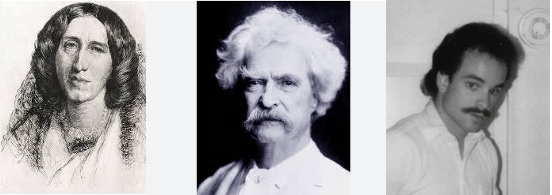
Throughout history, writers have often chosen to step aside from their given names and write under something else. Not to deceive, but perhaps to create space. Space for thought. Space for experimentation. Space for the work to speak before the author does.
One of the most recognizable examples is Mark Twain, an early American writer. Born Samuel Langhorne Clemens, he adopted a pen name drawn from riverboat slang meaning “two fathoms deep”—safe water for navigation. The name fit him perfectly. It carried rhythm, a hint of humor, and a distinctly American flavor. More importantly, I’m guessing it allowed Clemens to write with a voice that felt both personal and universal, unburdened by the expectations attached to his real identity.
Then there’s George Eliot, the pen name of Mary Ann Evans. In 19th-century England, female writers were often dismissed as sentimental or trivial. Evans chose a male name not to hide, but to be taken seriously—to allow her ideas, not her gender, to lead. The result was some of the most profound literary work of the era, writing that still resonates because of its honesty and depth.
These are just two examples among many. Lewis Carroll. George Orwell. O. Henry. Even more contemporary writers have adopted alternate names to explore different genres, tones, or ideas without being boxed in by expectation. The reasons vary, but the motivation is often the same: freedom. A pen name, at its best, is not a mask. It’s a tool.
It gives the writer room to think clearly. To ask uncomfortable questions. To explore ideas without worrying how they might be interpreted through the lens of a résumé, a profession, or a past body of work. It invites readers to engage with the writing itself rather than the person behind it. That’s the tradition in which Kip Ocasek exists.
When I chose the name, I did so deliberately. It had no digital footprint. No history. No associations. No search results. It was a clean slate — a name that carried no expectations and no prewritten narrative. Everything connected to it would be built slowly, one piece of writing at a time. That mattered to me.
In an era where online identity is often curated, branded, and optimized before a single sentence is written, I wanted to reverse the process. I wanted the ideas to come first. The writing to stand on its own. The reader to decide what the name meant based solely on what it produced.
There’s also something quietly liberating about that approach. A pen name creates a small but meaningful separation between the writer and the work — not to hide responsibility, but to remove ego from the equation. It allows a writer to follow curiosity wherever it leads, to ask questions without pretense, and to write with a little more honesty than might otherwise feel comfortable.
That’s what Kip Ocasek is meant to be: a place for ideas, reflection, and careful examination of the world as it is — and sometimes as it ought to be. No persona. No performance. Just writing.
And in that sense, it follows a long and respected tradition. One shared by authors who understood that sometimes the clearest voice comes from stepping slightly out of the way.
 KIP OCASEK
Leave a comment