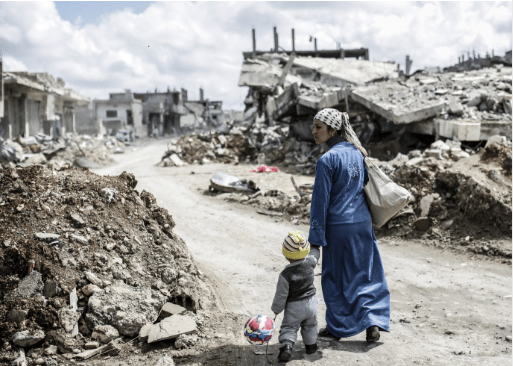
I wrote this essay some years ago as a contextual piece after the Syrian War began and death and destruction was foisted on the Syrian masses by the Bashir al-Assad regime. The message ages well, however, especially as people in many parts of the world still deal with and try to survive authoritarian regimes, arguably even in the United States.
Obscure circumstances are often precursors to major world events. The details of those circumstances are intriguing to history buffs, especially when the intricacies of the actions are examined in the aftermath of the major events. Throughout human history, many such occurrences are recorded by those who lived to tell the story.
Perhaps you may recall a junior high school history discussion regarding the First World War. Does the fateful date, June 28, 1914, ring any bells? That’s the date when the Archduke Franz Ferdinand of Austria and his wife Sophie were assassinated. That brutal act set in motion the string of events that led to World War I.
Most are familiar with the war currently raging in Syria. What most may not know, however, is that particular war had its own obscure precursor. To lay the foundation for that story, let’s take a quick look back in time, to December 2010. You may recognize this particular story as another such obscure precursor to a major world event – one that would later be known as the Arab Spring.
A young Tunisian street vendor by the name of Mohamed Bouazizi had been accosted by a police officer who confiscated the fruits and vegetables he was selling, because he lacked a vendor’s permit. In protest, Bouazizi found a can of gasoline, doused himself with it, and set himself on fire outside the local governor’s office.
Responding to Bouazizi’s actions and to protest their frustrations with corrupt authoritarian regimes they had known their whole lives, Arab youths all across the region took to the streets in protest. Soon, as a result of those violent demonstrations, Tunisian President Zine El Abidine Ben Ali went into exile, causing his regime to collapse. He was the first “domino” to fall. Later, demonstrations in Egypt led to the fall of Hosni Mubarak, and almost simultaneously, protests began in Yemen, which eventually led to regime change there.
The Arab Spring caused substantial political anxiety and upheaval in North African and Middle Eastern countries. Authoritarian governmental leaders throughout the region anticipated difficulties associated with the social and political fervor that defined the Arab Spring. It seemed young people everywhere were fed-up and weren’t going to take it anymore. And Syrian President Bashir al-Assad, already dealing with the rumblings of unrest due to a declining economy largely brought about by widespread drought, stood ready to crackdown should insurrections arise in his country.
Naief Abazid was a 14-year-old Syrian boy who, like many his age, sought acceptance by his group of friends. So, on February 16, 2011, he took a can of spray paint and wrote, “It’s your turn, Doctor Bashar al-Assad,” under the window of the principal’s office in his all-boy’s school in Daraa. The message was an incendiary idea that suggested Syria’s dictatorship would be the next to fall after the revolutions in Tunisia and Egypt. Naief and his friends thought the message was funny. That message, painted on a cool, winter day, would change Naief’s life forever and set in motion a series of events that would have far-reaching consequences for a whole nation.
The graffiti was exactly the rebellious act that President Bashar al-Assad anticipated. The next day, Naief was called out of the classroom by a man who wanted to question him about the graffiti. The man ushered him to a car waiting outside. Once in the car, he was handcuffed and taken to Syria’s feared internal security service, the Mukhabarat. According to his own accounting of events, for days, young Naief was tortured, beaten, kept in an isolation cell barely large enough for his body, and forced to reveal the names of others who were involved in the graffiti.
The Mukhabarat officers rounded up more boys involved and together with Naief, they were moved to the Palestinian Branch Mukhabarat headquarters in Damascus, and the painful interrogation process began anew. The process led Naief and his associates to a sense of despair, as they were held captive within a governmental punishment apparatus famous for its use of intimidation and terror.
Meanwhile, back in Daraa, the disappearance of so many of the community’s children into the hands of the Syrian security apparatus was something residents were unwilling to tolerate. A movement to set the boys free began stirring outside the prison walls.
Soon, a delegation of elders from Daraa gained audience with Atef Najib, a cousin of al-Assad, and the man in charge of Daraa’s security organization. The meeting failed when Najib insulted the elders and incited anger by refusing to adequately address the arrest of Naief and his friends. A few weeks later, Daraa citizens took to the streets in their own self- styled “Day of Rage” uprising.
Naief and his friends were soon released and sent back to Daraa, where they were welcomed like heroes. Residents lined the city streets and cheered as they passed. The stories of the boys’ harsh treatment infuriated the masses, however. Demonstrations soon became a daily affair, and the death toll rose as angry protestors were met by determined security forces and regime soldiers who opened fire on the crowds with live ammunition.
The rest of this sad story is documented in numerous press and governmental reports. Each successive protest by Syrian citizens was met by deadly force. The escalation of the violence was marked by al-Assad’s tenaciousness in clinging to power and not relinquishing his high position, as did his Egyptian and Tunisian counterparts.
Today, as Syria’s war rages on, the massive destruction is depicted in images of bombed- out cities and the expressions of pain and hopelessness written across the faces of Syrians fleeing their homeland in hopes of finding peace elsewhere. Last year, the British-based Syrian Observatory for Human Rights said that at least 511,000 people had been killed in the war since March 2011.
The number of refugees and displaced persons and families is equally staggering. As of November 2018, more than 5.6 million Syrians have fled the country, according to the UN High Commissioner for Refugees, and more than 6 million people are displaced internally.
People draw their own conclusions regarding the Syrian conflict. Some may choose to focus on the horrors of civil war when competing human ideals viciously collide. Some choose to focus on the human rights atrocities reported during the conflict. Some may choose to examine the proxy involvements in the war, when insurgents and other competing state militaries stepped in to protect their interests or to claim territory. But none can deny the intriguing, historical reality that a kid who sprayed graffiti on a schoolhouse wall led to the Syrian conflict. And that should give all cause for contemplation.
 KIP OCASEK
Leave a comment